
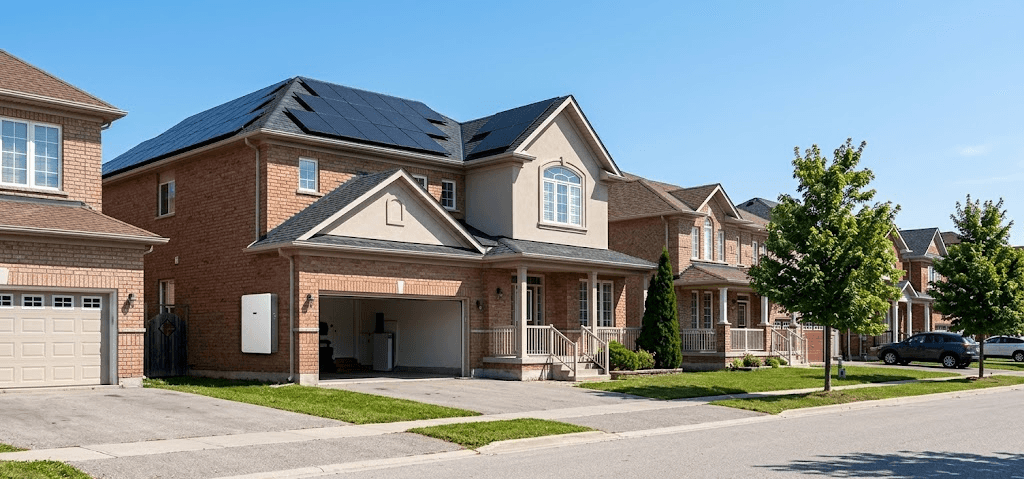
Why More Vaughan Property Owners Are Choosing Solar
The rapid adoption of residential and commercial Vaughan solar panels is fueled by a shifting economic landscape. Homeowners and local business operators are no longer looking at clean generation as an optional environmental milestone; it is a critical financial strategy to shield assets from energy rate inflation.
Vaughan’s unique blend of thriving communities like Woodbridge, Maple, Thornhill, Kleinburg, and Concord, progressive municipal green initiatives, and rapidly expanding commercial corridors along Highway 400 and Highway 407 features distinct energy demands. By deploying on-site solar generation, owners can drastically reduce electricity bills with solar across Ontario, creating an immediate barrier against rising energy costs while significantly reducing their aggregate carbon footprint.
Is Vaughan a Good Location for Solar Panels?
Vaughan is an exceptional geographic location for solar energy production. Situated in the heart of York Region in the Greater Toronto Area, the area benefits from bright, clear summer conditions and excellent annual solar irradiance that matches or exceeds many major metropolitan zones in Western Europe.
While seasonal variation means summer production outpaces winter output, high-efficiency monocrystalline panels generate substantial power year-round. Optimum generation is achieved on roofs with an unobstructed southern or southwestern exposure pitched between 30 and 45 degrees. Modern installations easily manage local environmental factors like temporary shade or winter snow accumulation through strategic panel layout engineering and microinverter integration.
How Much Does Solar Installation Cost in Vaughan?
When making a long-term capital improvement, transparency around hardware and permitting costs is essential. In the current market, the gross capital requirement for a turnkey solar installation in Vaughan ranges from $2.42 to $3.50 per watt, covering all premium equipment, engineering layout approvals, electrical grid hookups, and professional structural warranties.
Factors That Affect the Final Installation Price
The ultimate financial breakdown of your system depends on several physical and operational variables:
- Roof Material and Pitch: Metal seam roofs reduce racking labor, whereas steep concrete tiles or multi-story structures require advanced safety setups.
- Electrical Infrastructure Upgrades: Older properties requiring a main service panel upgrade from 100A to 200A will face minor additional pre-construction costs.
- System Architecture: Opting for modular microinverters rather than a single string inverter increases upfront hardware costs but significantly improves long-term output resilience.
To determine your precise upfront layout, our engineering teams evaluate your annual consumption alongside your physical roof footprint. If you want to know exactly how much do solar panels cost in Vaughan, the tables below map out the typical system capacity requirements and panel metrics needed to comfortably achieve energy independence:
Vaughan Residential Solar Sizing Matrix (Based on 420W Tier-1 Modules)
| Home Profile & Size | Typical Annual Consumption | Recommended System Size – DC (Watts / kW) |
| Small Home (Under 1,200 sq ft) |
5,000 – 7,000 kWh | 4,500W – 6,000W (4.5 – 6.0 kW) 11 – 14 Panels Required |
| Mid-Size Family Home (1,200 – 2,000 sq ft) |
7,000 – 10,000 kWh | 6,000W – 8,500W (6.0 – 8.5 kW) 14 – 20 Panels Required |
| Large Executive Home (2,000 – 3,000 sq ft) |
10,000 – 14,000 kWh | 8,500W – 12,000W (8.5 – 12.0 kW) 20 – 29 Panels Required |
Vaughan Commercial & Industrial Solar Sizing Matrix (Based on 550W Tier-1 Modules)
| Commercial Facility Profile | Typical Annual Consumption | Recommended System Size – DC (Watts / kW) |
| Micro-Commercial (Local Retail, Family Business Office) |
20,000 – 50,000 kWh | 15,000W – 40,000W (15.0 – 40.0 kW)40 – 83 Panels Required |
| Small-Medium Enterprise (Light Manufacturing, Main Warehouse) |
50,000 – 150,000 kWh | 40,000W – 120,000W (40.0 – 120.0 kW)83 – 250 Panels Required |
| Large Industrial / Agriculture (Cold Storage Plant, Advanced Processing Hub) |
150,000 – 500,000+ kWh | 120,000W – 400,000W+ (120.0 – 400.0+ kW)250 – 830+ Panels Required |
Note: Individual financial metrics, precise system layouts, and exact panel counts will fluctuate naturally based on roof orientation, architectural pitch, localized shading factors, historical property consumption brackets, and the specific utility rate framework selected.
How Much Can Solar Panels Save in Vaughan?
Your ongoing financial return is dictated by three primary metrics: your property’s daily consumption habits, the total physical footprint of the array, and your current utility billing schedule.
An average detached household in Vaughan consuming 9,000 kWh annually can comfortably offset 70% to 90% of their consumption with a well-designed 8 kW solar array. By shifting daytime loads to self-generation or feeding energy back to the grid, the typical family saves an estimated $1,400 to $1,900 per year in retail utility bill charges.
A medium-sized enterprise in Concord or along the Highway 400 corridor using manufacturing, industrial, or logistics equipment can leverage an optimized commercial rooftop matrix to avoid premium time-of-use pricing peaks. A 100 kW system generating roughly 115,000 kWh annually saves an enterprise an estimated $15,000 to $22,000+ per year, protecting the company’s bottom line from rising energy rates.
Solar Payback Period in Vaughan
Thanks to high regional efficiency and robust grant optimization, the typical residential solar asset features a simple payback period of 7.5 to 9.5 years. Commercial installations utilizing accelerated tax write-offs can achieve an even faster payback of 4.5 to 6 years, converting the system into a pure profit-generating asset for the remainder of its 25+ year operational life.
Solar Rebates and Incentives Available in Vaughan
Maximizing your return on investment relies on stacking active public, utility, and federal financial incentives.
Ontario Residential Solar and Battery Programs
Homeowners in Vaughan can strategically choose between distinct regulatory pathways to capture premium financial benefits:
| Solar Program & Pathway | Financial Incentives & Rebates | Grid Operational Model | Target Profile |
| Polaron Exclusive Offer | • $3,200 Polaron Solar Rebate
• Competitive in-house financing (EAAS, also known as Sunline) |
Turnkey Financial Relief: Direct upfront price reduction combined with flexible monthly payment plans designed so energy savings offset payments. | Homeowners looking for immediate capital savings and flexible in-house financing without relying solely on bank loans. |
| Ontario’s Home Renovation Savings Program | • $1,000 per kW installed (Max $5,000 for panels)
• Up to an additional $5,000 for qualifying batteries |
Behind-the-Meter Load Displacement: Systems are engineered strictly for self-consumption. Solar energy is stored or used entirely on-site with no grid export. | Homeowners prioritizing massive upfront capital relief who want to maximize emergency battery backup power. |
| Ontario Net Metering Program | • 1:1 retail rate credits applied directly to your hydro statement
• Credits roll forward for up to 12 months |
Grid-Tied Bidirectional Metering: Your local utility installs a smart meter to track imports and exports. Surplus summer generation runs your bill backward. | Homeowners with large, unobstructed roof layouts that generate a substantial daily or seasonal energy surplus. |
Commercial Solar and Battery Incentives
Enterprise operations can leverage powerful commercial solar incentives Vaughan-wide to offset upfront deployment friction:
| Incentive Program & Framework | Financial Capital Support Details | Strategic Operational Advantage |
| IESO SaveOnEnergy Retrofit Program | • $770 / kW-AC of prescriptive nameplate capacity
• Maximum program funding cap up to $770,000 |
Direct Upfront Capital Relief: Subsidizes hardware and engineering deployment costs via the active SaveOnEnergy solar rebate 2026 framework. |
| Federal Clean Technology Investment Tax Credit (ITC) | • 30% fully refundable investment tax credit
• Can stack with CCA write-offs |
Direct Corporate Tax Shield: Applied directly against the total capital expenditures of eligible hardware, battery storage, and installation costs. |
Financing Options for Vaughan Property Owners
To bypass initial capital barriers, property owners can look to specialized clean energy lending frameworks. Local homeowners can capitalize on available financing paths from trusted clean energy authorities designed to support structural eco-retrofits. These mechanisms make rooftop upgrades completely manageable without tying up personal line of credit limits. Property owners can seamlessly deploy these financial assets alongside the active provincial Home Renovation Savings Program Ontario (load-displacement pathway) to maximize the economic return of their structural retrofits.
Concurrently, Polaron provides highly competitive internal financing streams through our dedicated Energy-as-a-Service (Sunline) channels. Residential and commercial installations alike can leverage tailored low-interest or special 0% financing options engineered explicitly to ensure that your immediate monthly hydro bill drop permanently outpaces your low technology payment.
How Net Metering Works in Vaughan
If you choose to bypass behind-the-meter load-displacement grant paths to maintain a traditional grid-tied connection, you can enroll in the popular Alectra Utilities net metering or Hydro One net metering program depending on your property’s service zone. This program is fully available to both residential households and commercial operations within the local network, allowing property owners to leverage the public grid to optimize their generation economics.
How Solar Credits Appear on Your Electricity Bill
When you enter a net metering agreement, your local utility provider coordinates an official grid connection and installs a specialized bidirectional smart meter. When your solar system produces more electricity than your property consumes during peak daylight hours, the surplus flows back to the public grid.
The utility tracks this volume and applies a non-cash credit directly to the electricity consumption line item on your monthly hydro statement, officially recorded as your “Generation Credit Balance.” For both residential and commercial accounts, this credit directly offsets volumetric energy charges.
Net Metering Versus Battery Storage
Net metering utilizes the public utility grid as a virtual battery, allowing you to store financial value in the form of an Energy Credit / Solar Credit. Physical battery storage, conversely, keeps your energy completely behind the meter for direct load displacement. The core trade-offs between these two frameworks include:
- Net Metering: Excellent for long-term seasonal generation balancing (using summer abundance to offset winter demand), but it does not provide backup power during grid blackouts due to anti-islanding safety regulations.
- Battery Storage: Provides total operational resilience and instantaneous backup power. For commercial facilities, behind-the-meter battery matrices unlock advanced peak-shaving capabilities to actively lower global adjustment fees and demand surcharges.
What Happens to Unused Solar Credits
During high-production summer months, your system will accumulate a substantial reserve of generation credits, commonly known as a Solar Credit. Under current Ontario Energy Board (OEB) rules, these credits roll forward to offset subsequent monthly statements, allowing you to use your summer abundance to pay for your winter heating or operational demand. However, unused credits remain valid on your account for a maximum rolling 12-month cycle, after which any remaining credit balance expires and is reduced to $0. Systems must be engineered precisely to prevent over-sizing beyond your annual historical load.
Do You Need a Battery with Solar Panels?
Choosing whether to integrate physical energy storage (Behind-the-meter / Load Displacement) depends entirely on your property’s specific backup requirements, operational risk profile, and target utility billing structure.
Solar Without Battery Storage
A standard grid-tied solar system without a battery supports self-consumption and yields solar credits in exchange for surplus energy under a traditional net metering framework. The primary limitation is grid dependence: if a localized storm or winter grid failure knocks out municipal power lines, a standard grid-tied system automatically de-energizes to protect utility line workers, leaving your home or business without power during blackouts.
Solar with Battery Backup
Pairing your solar system with an advanced lithium-iron-phosphate (LFP) battery storage system unlocks complete operational autonomy. If the local grid fails, the system instantly isolates your property into an independent micro-grid within milliseconds, keeping critical infrastructure running seamlessly.
- For Homeowners: It ensures lighting, medical equipment, refrigeration, well pumps, and heating systems remain operational through extended winter outages.
- For Commercial Facilities: It protects delicate inventory, keeps data centers online, prevents costly assembly line restarts, and secures business continuity.
How Much Battery Capacity Does a Vaughan Property Need?
| Property Profile | Storage Capacity Range | Coverage |
| Residential Essential Backup | 10 kWh – 13.5 kWh | Powers baseline emergency loads: refrigeration, Wi-Fi routers, device charging, and select lighting networks. |
| Residential Whole-Home Backup | 20 kWh – 30 kWh | Supports heavy-draw residential appliances: central air conditioners, well pumps, electric dryers, and EV chargers. |
| Commercial / Enterprise Backup | 30 kWh – 100 kWh+ | Engineered to sustain critical business infrastructure: server rooms, security networks, emergency lighting, and essential production machinery. |
Is Your Vaughan Property Suitable for Solar?
Before moving forward with active hardware orders, our site assessment teams review five foundational variables to ensure absolute structural safety:
- Roof Direction and Pitch: The ideal architectural setup features an unobstructed southern, southeastern, or southwestern roof face. A roof pitch between 28 and 40 degrees allows for optimal year-round sunlight collection and facilitates natural snow shedding during regional winter storms.
- Roof Age and Structural Condition: Solar panels feature an operational lifespan exceeding 25 to 30 years. Polaron strongly recommends that your roof shingles or metal base have at least 15+ years of structural life remaining before deployment. If your roof is approaching the end of its lifecycle, replacing the shingles immediately prior to panel placement avoids future uninstallation fees.
- Trees, Buildings, and Shading: Persistent shade from neighboring mature trees or nearby multi-story developments reduces the operational yield of solar panels. Our team utilizes advanced 3D solar irradiance software to map shade footprints, integrating high-performance microinverters to isolate shaded panels and ensure the rest of your system operates at peak capacity.
- Ground-Mounted Solar Options: If your roof faces heavy shading, complex architectural dormers, or poor historical orientation, ground-mounted solar systems are an excellent alternative for spacious acreage lots near Kleinburg and rural boundaries. Ground mounts allow for perfect orientation and pitch optimization, though they require minor trenching and dedicated structural concrete foundations.
The Solar and Battery Installation Process in Vaughan
Polaron manages every single phase of your renewable transition through a proven, comprehensive service model:
We manage the entire bureaucratic process on your behalf, submitting complete engineering packages to secure local municipal building permits and coordinating directly with local utilities to secure your formal Alectra Utilities pre-approvals or Hydro One solar connection.
Following installation, we coordinate the mandatory Electrical Safety Authority (ESA) inspection. Once the field safety certificate is granted, the utility activates your bidirectional meter, formally authorizing your system to connect to the grid.
Solar Permits and Approvals in Vaughan
Operating grid-tied energy infrastructure requires strict adherence to regional safety rules. A standard deployment requires an active Building Permit from the City of Vaughan (Building Standards Department) to certify structural roof loading safety under local snow conditions.
Furthermore, all electrical configurations must strictly comply with the Ontario Electrical Safety Code, verified by an official ESA Certificate of Inspection. Finally, a formal micro-embedded generation agreement must be finalized through your local utility network (Alectra Utilities or Hydro One) before your system can legally export a single kilowatt-hour. Polaron manages this complete permitting process internally to ensure a smooth transition.
How Long Does a Solar Installation Take in Vaughan?
While the physical on-site installation of the racking and panels requires only 1 to 2 days of active labor, the macro project timeline typically spans approximately 5 to 6 months. This standard window is dictated by utility interconnection processing queues, municipal structural review timelines, and scheduling the final ESA safety sign-off. Commercial projects with large system sizes are expected to have a longer timeline due to increased project complexity. Polaron handles all logistics to ensure your system moves through the approval pipelines as efficiently as possible.
Do Solar Panels Work During Vaughan Winters?
Yes, solar panels perform exceptionally well during classic Southern Ontario winters. Photovoltaic technology relies entirely on solar light rather than ambient heat, meaning panels operate with heightened electrical efficiency in cold, crisp temperatures.
While shorter winter days and heavy snow accumulation cause a seasonal drop in generation compared to the summer months, snow quickly melts or slides off the slick, dark glass surfaces of angled panels. Your system is engineered to capture the vast majority of its annual production targets between March and October, easily absorbing winter drops.
Solar Panels for Vaughan Businesses, Warehouses and Industrial Buildings
Commercial enterprises, distribution hubs, and industrial operators across Vaughan can turn their expansive roof profiles into active financial shields against volatile wholesale power markets.
Commercial Rooftop Solar
Medium and large industrial facilities across Concord and Woodbridge can utilize expansive commercial roof space to deploy high-output solar arrays. This infrastructure converts a fixed monthly operating expense into an independent capital asset, dramatically increasing commercial building equity.
Solar for Warehouses and Industrial Buildings
Warehouses, distribution centers, and logistics facilities across Vaughan’s business corridors feature massive, unobstructed flat roofs. These footprints are ideal for ballast-mounted, non-penetrating solar matrices that maximize generation yield without compromising building membrane integrity.
Solar for Rural Properties
Rural properties and acreage estates near Kleinburg face distinct energy demands. These properties are uniquely positioned to maximize clean energy investments due to their abundant space and ground-mount availability.
If roof structures feature complex orientations or steep architectural angles, rural properties can deploy ground-mounted solar systems. Ground mounts allow engineering teams to angle and position arrays perfectly for maximum year-round solar capture.
Note: Ground-mount solar panels are not eligible for the SaveOnEnergy Retrofit Program.
How to Choose a Solar Installer in Vaughan
Selecting the right partner to design, permit, and construct your multi-decade clean energy asset is the most important decision you will make. Use this essential buyer checklist when evaluating providers:
- Installation Experience and Local Knowledge: Ensure your provider has a verified track record of successful installations within Ontario’s specific grid jurisdictions. An experienced installer understands the localized engineering requirements needed to secure approvals through Alectra Utilities and Hydro One efficiently.
- Licensing, Insurance, and Electrical Qualifications: Never compromise on field safety. When searching for the best solar company in Vaughan, checking verified qualifications is essential. Your chosen provider must hold an active Electrical Contractor license issued by the ESA, employ certified master electricians, and carry comprehensive commercial general liability insurance along with active WSIB coverage.
- Equipment and Workmanship Warranties: Premium installations should only feature Tier-1 hardware backed by a 25-year linear performance warranty (Polaron offers a 30-year warranty for solar panels) from established manufacturers. Additionally, look for an installer that provides a comprehensive in-house workmanship warranty to cover all roof flashing and structural racking connections.
- Financing and Rebate Support: Navigating complex grant programs can be incredibly challenging. Choose a full-service partner with an integrated administrative division that manages your Home Renovation Savings Program Ontario applications and helps align your property with flexible financing routes.
- Monitoring and After-Sales Service: Your solar journey shouldn’t end once the panels are secured to your roof. Ensure your installer provides continuous cloud-based system monitoring software and has a dedicated customer support team ready to manage technical service and maintenance needs for decades to come.
Why Choose Polaron as Your Solar Installer in Vaughan?
As the largest solar installer in Ontario with a proven track record of over 14,000 successful installations, Polaron Solar delivers a 100% turnkey clean energy transition, establishing absolute financial independence for homeowners and commercial enterprises alike. Holding elite ESA/ECRA certification, our experienced in-house teams guarantee flawless safety compliance and strict adherence to the Ontario Electrical Safety Code throughout the entire project lifecycle. By expertly managing everything from custom 3D engineering layouts and City of Vaughan building permits to local utility grid connections and maximum incentive capture, Polaron pairs top-tier technology with in-house financing options to permanently shield your property from rising hydro inflation and generate immediate, cash-flow-positive utility savings.
Get a Solar Installation Assessment in Vaughan
Ready to turn your roof into a high-yield independent power asset? Don’t leave thousands of dollars in active provincial energy grants on the table.
Contact Polaron Solar today to schedule your comprehensive, complimentary solar feasibility assessment and take complete control of your energy future.
Frequently Asked Questions
- Is solar worth it in Vaughan?
Yes. Backed by excellent regional sun hours, active provincial cash-back rebates, and a stable net metering framework, installing solar allows you to shield your property from climbing utility inflation and lock in low-cost energy for decades. - How much does it cost to install solar panels in Vaughan?
Turnkey commercial and residential installations typically range between $2.42 and $3.50 per watt. A standard 8 kW residential rooftop array requires an estimated gross investment of $22,000 to $28,000 before applying eligible provincial grants. The cost could be affected by property location and roof angle; please contact your solar installer for an accurate quotation. - Are solar rebates available in Vaughan?
Yes. Homeowners can tap into the active Home Renovation Savings Program Ontario framework to claim up to $5,000 for panels and up to $5,000 for qualifying battery systems. Commercial operations can secure prescriptive utility incentives of $770 per kW AC. Polaron also offers an exclusive $3,200 rebate. - How many solar panels do I need for my Vaughan home?
The typical detached residential home requires an array size between 7 kW and 12 kW to balance its utility footprint, which translates to roughly 14 to 29 premium solar panels depending on your total historical consumption. - Can solar panels eliminate my electricity bill?
Under the Ontario net metering program, your solar system can comfortably generate enough credit to wipe out your usage charges over a 12-month cycle. However, you will still receive a minimal monthly bill to cover standard fixed customer delivery charges. - Do solar panels work during Vaughan winters?
Yes. Solar panels operate with excellent efficiency in cold, clear winter conditions. Angled installations allow snow to naturally shed, and systems are engineered to comfortably absorb seasonal winter drops. - Can I add a battery after installing solar?
Yes. While integrating a battery storage system during your initial solar installation maximizes your financial return and simplifies the electrical permitting process, you can easily retrofit a smart battery backup to an existing solar system down the road. - Does solar increase property value in Vaughan?
Yes. Multiple real estate economic studies confirm that buildings equipped with independent, revenue-generating clean energy infrastructure command a premium market value and sell significantly faster than properties fully reliant on the public grid. - How long do solar panels last?
Premium Tier-1 monocrystalline panels are engineered for exceptional durability, featuring an operational lifespan of 30+ years. Most systems continue to produce reliable, clean electricity well beyond their initial 30-year warranty period. - How long does the installation process take?
The actual physical rooftop construction requires only 1 to 2 business days. However, the full end-to-end lifecycle, including architectural design adjustments, municipal building permit reviews, and final utility grid activation, takes approximately 5 to 6 months.
Related Articles
- Choosing Canada’s Most Trusted Solar Installer: A Deep Dive into Polaron Solar Energy
- Ontario Retrofit Program Change: IESO Boosts Commercial Grants, But Sets Strict June 30 Deadline for Solar
- Find The Best Solar Companies in Ontario 2026
- 30% Federal Clean Technology Investment Tax Credit For Commercial Solar
- Net Metering vs Behind the Meter for Residential Solar 2026: Which is Right for Your Home?
- Peak Shaving in Canada and Why It Quietly Saves Businesses Money



.70e3bcd1.svg)
.6c51ffe3.svg)
.8cbc05bd.svg)
.d07f37ca.svg)
.a26b3396.svg)
.29c01fed.svg)