
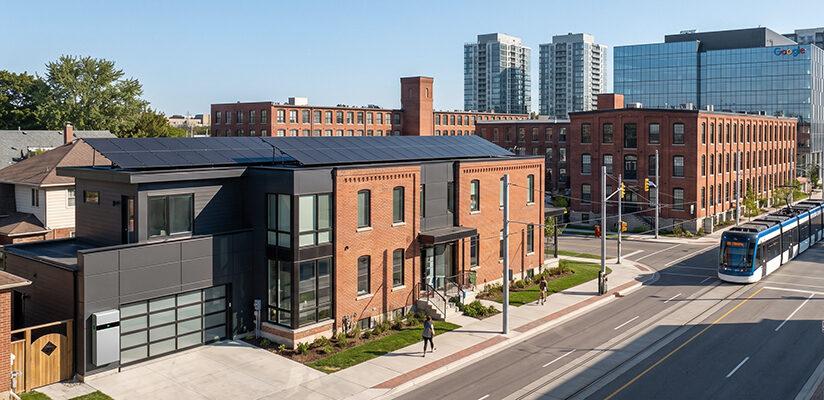
A common regional myth suggests that Southwestern Ontario lacks the necessary climate profile for viable solar deployment. However, meteorological data disproves this: Kitchener receives excellent annual solar resource numbers, averaging 3.6 to 4.5 peak sun hours per day. For property owners throughout the area, executing a solar installation in Kitchener is no longer a speculative environmental trial, it is a proven, highly calculated financial strategy.
The Trend of Solar Installation in Kitchener
The deployment velocity of Waterloo region solar panels has accelerated dramatically over the past several years. Kitchener, Ontario, is witnessing a major clean infrastructure boom, driven by decentralized microgeneration assets that feed clean electricity directly into local building distribution networks.
As municipal frameworks prioritize strict carbon reduction targets and grid capacity constraints loom during high-demand summer peak hours, the adoption of behind-the-meter energy architecture has transitioned into mainstream real estate development. Modern buyers view solar arrays not as optional add-ons, but as core components necessary to protect properties from long-term utility inflation.
The Material Benefits of Residential Solar
For residential property owners, deploying a high-efficiency rooftop array paired with smart battery storage creates an immediate buffer against volatile electricity bills. The financial foundation of a residential solar installation in Kitchener is anchored by the net metering Ontario regulation framework. Under an active net metering agreement with Enova Power, whenever your rooftop solar array generates more electricity during sunny afternoons than your home is actively drawing, the excess power is automatically exported to the grid. Your account receives a direct generation credit that rolls forward for up to 12 consecutive months, allowing your high summer overproduction to directly offset your winter grid power consumption.
To optimize this layout, homeowners can access the newly expanded Save on Energy program (under the Home Renovation Savings initiative backed by the Ontario Government), which provides up to $10,000 in direct rebates for combining solar panels with home battery storage assets. Also, homeowners could qualify for the special rebate of up to $3,200 exclusively from Polaron. This configuration creates a critical domestic safety net, ensuring your household stays fully powered during localized substation disruptions, extreme winter weather events, or grid brownouts.
Residential Rebate Matrix (2026 Incentives)
| Active Framework | Provincial Save on Energy Program (Home Renovation Savings Suite) |
| Maximum Available Subsidy | Up to $10,000 for Solar Panels + Integrated Battery Storage |
| Polaron Exclusive Rebate | Up to $3,200 |
| Structural Benefit | Against substation failures and intense winter ice storms |
Last Update: July 10, 2026
The Strategic Advantages of Commercial Solar + BESS
For enterprise operators looking to insulate corporate profit margins, deploying commercial solar power Kitchener infrastructure delivers a definitive operational advantage. Commercial and industrial facilities typically suffer from high daytime demand peaks, matching exactly when solar panel generation is at its absolute maximum. To capitalize on this, corporations can leverage the provincial Save on Energy program Retrofit stream to deploy a highly efficient behind-the-meter system.
Commercial Rebate & Incentive Structure (Critical 2026 Deadlines)
| Solar Generation Over 10 kW (Pre-June 30, 2026 Rate): | $860 per kW AC nameplate capacity. Rebate Amount Up to $860,000. |
| Solar Generation Over 10 kW (Post-June 30, 2026 Rate): | $770 per kW AC nameplate capacity. Rebate Amount Up to $770,000. |
| Maximum Eligible Incentive Project Cap: | Funding scales up to 50% of total project costs |
| Polaron Exclusive Incentive: | $0 Net Cost 27 kWh Battery Enegy Storage System (BESS) – worth up to $17,000 |
Last Update: July 10, 2026
⚠️ Critical 2026 Policy Deadline: The Save on Energy Retrofit Program is undergoing a semi-annual rate recalibration. For commercial rooftop systems greater than 10 kW AC up to 1 MW AC, the prescriptive rebate drops by 10% on June 30, 2026, falling from $860/kW AC down to $770/kW AC. Complete engineering applications submitted and locked into the IESO portal prior to June 30th will secure the higher $860/kW funding tier. Note that wall-mounted solar DERs have been completely removed from eligibility under the latest spring criteria updates.
Beyond direct utility bill reductions, corporations can stack these provincial rebates with federal fiscal policies. Corporations can leverage the federal clean technology investment tax credit to claim a refundable tax credit of up to 30% of the capital expenditure of eligible solar generation and storage assets. When combined with accelerated Capital Cost Allowance (CCA) rules, which allow for an immediate 100% depreciation write-off of eligible clean energy hardware in the first year of operation, going solar functions as an exceptional corporate tax mitigation tool.
Furthermore, integrating an intelligent battery energy storage system business layout (BESS) allows for highly profitable “peak shaving.” The battery automatically discharges stored solar energy during high-tariff utility periods, cutting your facility’s peak demand from the grid and permanently eliminating expensive demand charges.
Breaking Down the Cost of Solar Installation
The exact capital deployment required for a project depends on a variety of site-specific factors, including roof material conditions, total surface areas, electrical panel configurations, and chosen financing structures.
- Residential Parameters: The average baseline residential solar cost in Ontario market matrix typically ranges between $15,000 and $28,000 before active incentives, depending heavily on the total system kilowatt capacity required to fully offset the home’s consumption history.
- Commercial Parameters: Industrial and corporate configurations require dedicated, multi-variable engineering, but benefit from significant volume economies of scale on raw hardware procurement.
When evaluating these upfront costs, smart investors look at the true solar array payback period. Thanks to modern tier-1 panel degradation limits keeping assets highly productive for 25 to 30 years, most Kitchener installations fully self-amortize within a compressed 6-to-9-year window. This leaves owners with up to two decades of completely free, self-generated electricity.
The Critical Reason to Include Battery Storage
While grid-tied solar panels provide exceptional daily cost offsets, integrating an advanced energy storage system unlocks a completely new tier of operational control.
For homeowners, pairing solar with a home solar battery protects the household against grid outages caused by localized sub-station failures or severe winter ice storms. For commercial facilities, deploying a battery energy storage system business setup allows for highly profitable “peak shaving.” The intelligent battery system monitors building consumption spikes in real time and automatically discharges its stored solar power during the utility’s most expensive peak-rate windows. This lowers the facility’s peak demand draw from the central grid, permanently eliminating expensive demand surcharges.
Summary
Executing a solar installation in Kitchener represents a smart convergence of environmental responsibility and financial foresight. Supported by strong annual solar irradiance, protected by net metering laws, and backed by robust tax incentives, transitioning your Kitchener property to solar energy is the single most effective way to reduce utility rate volatility and secure permanent power independence. Act now to explore more for solar installation in Kitchener.
Frequently Asked Questions
1. How does net metering work with Enova Power in Kitchener?
Through net metering Ontario regulations, Enova Power allows grid-connected systems to export surplus solar electricity back into the localized network for a 1:1 retail credit that rolls over monthly to offset winter utility bills. However, property owners face a strategic choice between this export model and the provincial Save on Energy program incentives. Opting for the upfront behind-the-meter Ontario rebate through the Home Renovation Savings Program—which awards up to $5,000 for solar and $5,000 for battery storage—requires your array to be configured as a non-exporting behind-the-meter system optimized strictly for localized load displacement instead of grid export. This means you must choose between building a traditional net-metering configuration to bank ongoing Enova billing credits or deploying a non-exporting layout to capture thousands in immediate rebate funding.
2. What is the typical solar array payback period for a business in the Waterloo Region?
The average solar array payback period for local commercial properties typically falls between 5 and 7 years. This rapid capital recovery is driven by high daytime commercial energy utilization, the ability to eliminate peak demand surcharges, and massive fiscal incentives like Canada’s 30% clean technology investment tax credit. Take advantage of Polaon in-house financing, your business could be cash-position at the first year.
3. What factors influence the baseline residential solar cost in Ontario?
The net residential solar cost in Ontario calculation is influenced by total system size, roof pitch, structural orientation (south-facing is optimal), shading from mature trees, and the selection of microinverters versus string inverters. Polaron helps reduce high out-of-pocket costs by providing exclusive low-interest financing options tailored to your household budget.
Related Articles
- Choosing Canada’s Most Trusted Solar Installer: A Deep Dive into Polaron Solar Energy
- Ontario Retrofit Program Change: IESO Boosts Commercial Grants, But Sets Strict June 30 Deadline for Solar
- Find The Best Solar Companies in Ontario 2026
- 30% Federal Clean Technology Investment Tax Credit For Commercial Solar
- Net Metering vs Behind the Meter for Residential Solar 2026: Which is Right for Your Home?
- Peak Shaving in Canada and Why It Quietly Saves Businesses Money



.70e3bcd1.svg)
.6c51ffe3.svg)
.8cbc05bd.svg)
.d07f37ca.svg)
.a26b3396.svg)
.29c01fed.svg)