
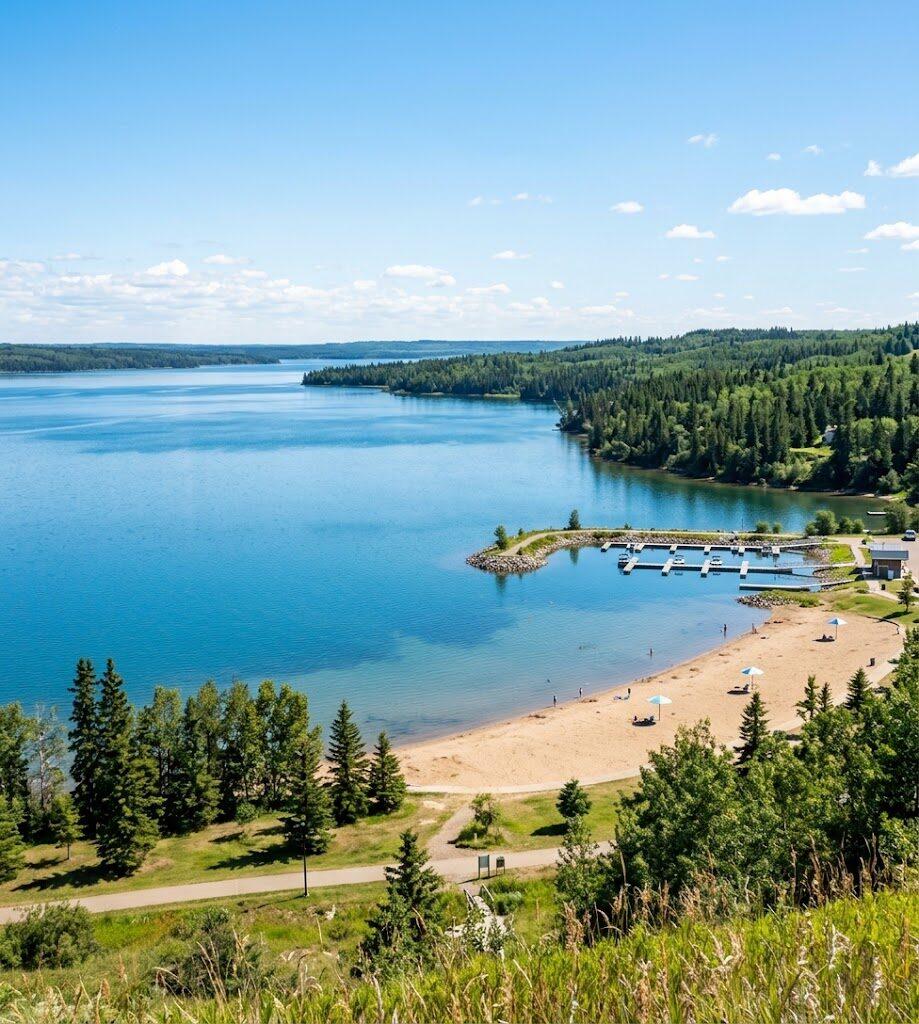
Why More Cold Lake Property Owners Are Choosing Solar Self-Generation

Is Cold Lake a Good Location for Solar Panels?
Cold Lake is an exceptional geographic location for solar energy production. Situated in the sunny Lakeland region of Northeastern Alberta, Cold Lake receives over 2,200 to 2,300+ hours of bright sunshine per year—far outpacing almost every major metropolitan zone in Eastern Canada and Western Europe. While shorter winter days reduce seasonal output compared to summer peaks, cold northern temperatures actually enhance photovoltaic (PV) panel efficiency. High-efficiency monocrystalline panels generate substantial self-generation power year-round. Optimum generation is achieved on roofs with an unobstructed southern or southwestern exposure pitched between 30 and 45 degrees. Modern installations easily manage local environmental factors like heavy northern snow accumulation or strong lakeside gusts through strategic racking engineering and microinverter integration.
How Much Does Solar Installation Cost in Cold Lake?
When making a long-term capital improvement, transparency around hardware and permitting costs is essential. In the current market, the gross capital requirement for a turnkey solar installation in Cold Lake ranges from $2.42 to $3.50 per watt, covering all premium equipment, engineering layout approvals, electrical grid hookups, and professional structural warranties.Factors That Affect the Final Installation Price
Steep asphalt shingles, standing seam metal roofs, architectural gables, or historic multi-story structures require specialized attachments and safety setups.
Older properties requiring a main service panel upgrade from 100A to 200A will face minor additional pre-construction costs.
Opting for modular microinverters rather than a single string inverter increases upfront hardware costs but significantly improves long-term output resilience on roofs with complex architectural valleys or shade from mature trees.
Cold Lake Residential Solar Sizing Matrix (Based on 420W Tier-1 Modules)
| Home Profile & Size | Typical Annual Consumption | Recommended System Size – DC (Watts / kW) |
| Small Home / Townhome (Under 1,200 sq ft) | 5,000 – 7,000 kWh | 4,500W – 6,000W (4.5 – 6.0 kW) 11 – 14 Panels Required |
| Mid-Size Family Home (1,200 – 2,000 sq ft) | 7,000 – 10,000 kWh | 6,000W – 8,500W (6.0 – 8.5 kW) 14 – 20 Panels Required |
| Large Executive / Acreage Home (2,000 – 3,000 sq ft) | 10,000 – 14,000 kWh | 8,500W – 12,000W (8.5 – 12 kW) 20 – 29 Panels Required |
Cold Lake Commercial & Industrial Solar Sizing Matrix (Based on 550W Tier-1 Modules)
| Commercial Facility Profile | Typical Annual Consumption | Recommended System Size – DC (Watts / kW) |
| Micro-Commercial (Local Retail, Office) | 20,000 – 50,000 kWh | 15,000W – 40,000W (15.0 – 40.0 kW) 40 – 83 Panels Required |
| Small-Medium Enterprise (Commercial Facility, Warehouse) | 50,000 – 150,000 kWh | 40,000W – 120,000W (40.0 – 120.0 kW) 83 – 250 Panels Required |
| Large Industrial / Ag Facility (Industrial Park, Service Center) | 150,000 – 500,000+ kWh | 120,000W – 400,000W+ (120.0 – 400.0+ kW) 250 – 830+ Panels Required |
Note: Individual financial metrics, precise system layouts, and exact panel counts will fluctuate naturally based on roof orientation, architectural pitch, localized shading factors, historical property consumption brackets, and the specific utility rate framework selected.
How Much Can Solar Panels Save in Cold Lake?
Your ongoing financial return is dictated by three primary metrics: your property’s daily consumption habits, the amount of energy offset via on-site self-generation, and your active retail electricity agreement.
For a Cold Lake Home
An average detached household or acreage property in Cold Lake consuming 9,000 kWh annually can comfortably offset 70% to 90% of their consumption with a well-designed 8 kW solar array. By maximizing daytime self-generation and switching to high micro-generator export rates during summer months, the typical family saves an estimated $1,600 to $2,200 per year in retail utility charges.For a Cold Lake Business
A medium-sized business, commercial workshop, or industrial facility in the Cold Lake region using heavy machinery, refrigeration, or HVAC systems can leverage an optimized rooftop or ground-mounted matrix for load displacement. A 100 kW system generating roughly 120,000+ kWh annually saves an enterprise an estimated $16,000 to $24,000+ per year, protecting operational margins from volatile power pricing and distribution fees.Solar Payback Period in Cold Lake
Thanks to strong solar irradiance and high summer export credit rates, residential solar assets in Cold Lake feature an exceptionally rapid payback period of 6.0 to 8.0 years. Commercial and industrial installations utilizing accelerated tax write-offs can achieve an even faster payback of 4.0 to 5.5 years, converting the system into a pure profit-generating asset for the remainder of its 25+ year operational life.Solar Incentives Available in Cold Lake
Maximizing your return on investment relies on stacking active federal corporate tax credits, utility net metering, provincial rebate pathways, and private incentive frameworks.
NS Residential Solar and Battery Incentive Frameworks
Homeowners and acreage owners in Cold Lake leverage Alberta’s unique micro-generation structure and self-generation economics to capture premium returns:| Solar Program & Pathway | Financial Incentives & Benefits | Grid Operational Model | Target Profile |
| Alberta Solar Club Network |
|
Grid-Tied Micro-Generation: Earn premium monetary credits for surplus self-generated solar energy exported during peak sun months via net billing. | Homeowners with grid-tied arrays seeking maximum monetary return on exported electricity. |
Commercial Solar Incentives in Alberta
Enterprise and industrial operations can leverage powerful commercial solar incentives in Alberta to offset upfront deployment friction:| Incentive Program & Framework | Financial Capital Support Details | Strategic Operational Advantage |
|
Federal Clean Technology Investment Tax Credit (ITC) |
|
Direct Corporate Tax Shield: Applied directly against the total capital expenditures of eligible hardware, battery storage, and installation costs. |
| Accelerated Capital Cost Allowance (Class 43.1 / 43.2) | First-year write-off for clean energy equipment |
Immediate Liquidity Boost: Allows incorporated businesses and farm operations to write off the full capital asset cost in year one. |
How Net Metering & Behind-The-Meter Work in Cold Lake
Understanding how your solar infrastructure connects to the grid and manages daily generation is key to choosing the right system architecture for your Cold Lake property.
Net Metering
Grid-tied solar systems in Cold Lake operate under the Alberta Micro-Generation Regulation. Administered through local wire service providers like FortisAlberta and competitive energy retailers, Alberta utilizes a net billing framework combined with on-site self-generation rather than simple 1:1 volumetric energy net metering.
The Dynamics of Self-Generation
- Self-Generation First: Electricity produced by your solar panels is consumed on-site first by your home, acreage, or business loads. This direct self-consumption displaces expensive retail power charges and variable FortisAlberta delivery fees.
- Exporting Surplus Power: When solar output exceeds your property’s immediate demand, the surplus power flows out through your bidirectional smart meter to the grid.
- Monetary Account Credits: Exported kWh earn direct dollar credits ($) applied to your monthly utility statement based on your active export rate.
How Solar Credits Work via Alberta Solar Clubs
Because Alberta operates a deregulated electricity market, micro-generators in Cold Lake can enroll in high-value Solar Club™ loyalty programs to maximize their self-generation economics:
- High Export Rate (Spring/Summer): Switch to a premium export rate (up to 35.00¢/kWh) during high-production months when your array generates a massive energy surplus. Every exported kWh earns substantial dollar credits applied to your utility statement.
- Low Consumption Rate (Fall/Winter): Switch back to a lower rate (e.g., 5.90¢/kWh) during darker winter months when self-generation drops, using your accumulated dollar credits to offset winter power and natural gas charges.
Behind-The-Meter (Load Displacement)
Choosing whether to integrate physical energy storage (Behind-the-meter / Load Displacement) depends entirely on your property’s specific backup requirements, operational risk profile, and target resilience goals.
Without Battery Storage
A standard grid-tied self-generation system without a battery supports daytime self-consumption and yields high credit returns under the Solar Club model. The primary limitation is grid dependence: if a localized storm or power outage knocks out FortisAlberta lines, a standard system automatically de-energizes to protect line workers.
With Battery Backup
Pairing your solar array with an advanced lithium-iron-phosphate (LFP) battery storage system unlocks complete operational autonomy. If the local grid fails, the system instantly isolates your property into an independent micro-grid within milliseconds, keeping critical infrastructure running seamlessly.
- For Homeowners: Ensures furnace fans, fridges, lights, well pumps, and medical devices remain powered through cold Alberta winter blackouts.
- For Commercial Facilities & Farms: Protects server rooms, security systems, cold storage, and essential production machinery.
Net Metering VS Behind-The-Meter (with Battery Storage)
Net metering utilizes the public utility grid as a virtual battery, allowing you to store financial value in the form of an Energy Credit / Solar Credit. Physical battery storage, conversely, keeps your energy completely behind the meter for direct load displacement. The core trade-offs between these two frameworks include:
Net Metering:
Excellent for long-term seasonal generation balancing (using summer abundance to offset winter demand), but it does not provide backup power during grid blackouts due to anti-islanding safety regulations.
Behind-The-Meter:
Provides total operational resilience and instantaneous backup power. For commercial facilities, behind-the-meter battery matrices unlock advanced peak-shaving capabilities to actively lower demand surcharges.
How Much Battery Capacity Does a Cold Lake Property Need?
| Property Profile | Storage Capacity Range | Coverage |
| Residential Essential Backup | 10 kWh – 13.5 kWh | Powers baseline emergency loads: refrigeration, Wi-Fi routers, device charging, and select lighting networks. |
| Residential Whole-Home Backup | 20 kWh – 30 kWh | Supports heavy-draw residential appliances: central air conditioners, well pumps, electric dryers, and EV chargers. |
| Commercial / Enterprise Backup | 30 kWh – 100 kWh+ | Engineered to sustain critical business infrastructure:server rooms, security networks, emergency lighting, and essential production machinery. |
Is Your Cold Lake Property Suitable for Solar?

Roof Direction and Pitch
The ideal architectural setup features an unobstructed southern, southeastern, or southwestern roof face. A roof pitch between 28 and 40 degrees allows for optimal year-round sunlight collection and natural rain/snow shedding.

Roof Age and Structural Condition
Solar panels feature an operational lifespan exceeding 25 to 30 years. Polaron strongly recommends that your roof shingle or metal base has at least 15+ years of structural life remaining before deployment.

Trees, Buildings, and Shading
Persistent shade from neighboring trees or farm structures reduces panel yield. Our team utilizes advanced 3D solar irradiance software to map shade footprints, integrating high-performance microinverters to isolate shaded panels.

Ground-Mounted Solar Options
For spacious rural acreage lots across the MD of Bonnyville No. 87 with heavy tree cover or complex architectural angles, ground-mounted solar arrays offer an ideal alternative with perfect angle and orientation optimization.
The Solar and Battery Installation Process in Cold Lake
Polaron manages every single phase of your renewable transition through a proven, comprehensive service model.
Electricity Usage and Property Assessment
We evaluate historical utility billing statements to pinpoint consumption habits and inspect structural rafters and main electrical panel capacity.
Solar System Design and Proposal
Our engineering division develops a custom 3D model of your property to maximize self-generation and outline transparent financial projections.
Permits and Utility Applications
We manage all administrative filings, securing local municipal building and development permits through the City of Cold Lake (or MD of Bonnyville No. 87 for rural outskirts) and submitting Form A micro-generation connection applications to FortisAlberta.
Equipment Installation
Certified installation crews deploy Tier-1 panels, racking, inverters, and battery storage within 1 to 2 business days on-site.
Inspection and Grid Connection
We coordinate required electrical safety inspections under the Alberta Electrical Safety Code before FortisAlberta installs the bidirectional meter.
Monitoring and System Activation
We energize your system and set up cloud-based mobile monitoring so you can track real-time self-generation and savings.
Solar Permits and Approvals in Cold Lake
Operating grid-tied energy infrastructure requires strict adherence to local regulations. Standard deployments require a Development and Building Permit from the City of Cold Lake (or MD of Bonnyville No. 87) to certify structural snow and wind load capacity. Furthermore, all electrical work must comply with the Alberta Electrical Safety Code (AESC), verified by a certified safety officer before FortisAlberta issues formal Authorization to Connect. Polaron manages this complete permitting process internally.

Do Solar Panels Work During Cold Lake Winters?
Yes, solar panels perform exceptionally well during Annapolis Valley winters. While winter daylight hours are shorter, photovoltaic technology relies on light, not heat, and solar panels actually operate with heightened electrical efficiency in cold temperatures. Furthermore, light reflection off surrounding snow (the albedo effect) boosts generation on clear winter days. Because dark panels are tilted and generate heat while producing power, light snow accumulation sheds quickly. Your self-generation system is engineered to capture the vast majority of its annual production targets during the long, sunny months between spring and autumn, banking enough net metering credits to comfortably absorb the winter dip.
Solar Panels for Cold Lake Businesses, Farms, and Commercial Buildings
Commercial enterprises, corporate offices, industrial service hubs, and agricultural operators across Cold Lake and the Municipal District of Bonnyville can turn their expansive roof or land profiles into active financial shields against rising power costs and volatile utility rates in Alberta’s deregulated energy market.

Commercial Rooftop Solar
Commercial plazas along 50th Avenue and 16th Avenue, light industrial facilities, oilfield supply centers, warehouses, and municipal buildings in Cold Lake can utilize expansive roof space to deploy high-output solar arrays. This infrastructure converts a fixed monthly operating expense into an independent capital asset, dramatically increasing commercial building equity.

Solar for Farms, Industrial Facilities, and Agriculture
Agricultural operations and commercial facilities across the Lakeland region face distinct energy demands, from operating heavy workshop equipment and cold storage units to powering grain handling, livestock ventilation, and irrigation lines. Producers, farm operators, and industrial business owners are uniquely positioned to maximize clean energy investments due to abundant roof and parcel availability. You can easily stack federal corporate tax incentives (such as the 30% Clean Technology Investment Tax Credit) with micro-generation savings to lock in a highly resilient source of low-cost energy.
How to Choose a Solar Installer in Cold Lake
Selecting the right partner to design, permit, and construct your multi-decade clean energy asset is the most important decision you will make. Use this essential buyer checklist when evaluating providers.
Choose a full-service partner like Polaron that manages your complex Alberta micro-generation interconnection paperwork with local wire service providers (such as ATCO Electric) and handles municipal permits in the City of Cold Lake and the Municipal District of Bonnyville. Polaron also offers an exclusive rebate up to $25,000 for commercial projects, alongside flexible in-house financing (Sunline) for both homeowners and business owners to reduce upfront capital barriers.
Ensure your provider has a verified track record of successful installations within Alberta’s specific deregulated grid framework, understands AUC (Alberta Utilities Commission) micro-generation guidelines, and thoroughly knows local building and electrical codes.
When searching for the best solar company in Cold Lake, verifying their technical qualifications is essential. Your chosen provider must employ certified electricians and carry comprehensive commercial general liability insurance along with active WCB (Workers’ Compensation Board Alberta) coverage.
Premium installations should only feature Tier-1 hardware backed by a 25-year linear performance warranty.
(Note: Polaron goes above the industry standard by offering an exclusive 30-year warranty for solar panels)
Ensure your installer provides continuous, cloud-based system monitoring software and has a dedicated customer support team ready to assist you for decades to come.
Why Choose Polaron as Your Solar Installer in Cold Lake?
As a proud Solar Alberta member and Canada’s premier clean energy authority with over 14,000 successful installations nationwide, Polaron Solar delivers a complete, 100% turnkey transition to financial independence. Our experienced in-house engineering and electrical teams guarantee strict compliance with the Alberta Electrical Safety Code throughout the entire project lifecycle. By expertly managing every single detail—from custom 3D solar layout modeling and City of Cold Lake building permits to FortisAlberta micro-generation connection approvals and AUC Rule 024 compliance—Polaron pairs top-tier technology with flexible internal financing options to permanently shield your property from utility inflation.
Being in the renewable energy industry for 13 years, with expert solar design, installation, and incentive support.
Ready to See If Solar Makes Sense for Your Property?
Get a customized solar assessment based on your property and electricity requirements.
Frequently Asked Questions
01 / Is solar self-generation worth it in Cold Lake?
Yes. With over 2,200+ annual hours of sunshine, high Alberta Solar Club export rates, and the ability to displace expensive retail electricity and FortisAlberta distribution fees, installing solar in Cold Lake yields excellent long-term returns.
02 / How much does it cost to install solar panels in Cold Lake?
Turnkey commercial and residential installations typically range between $2.42 and $3.50 per watt. A standard 8 kW residential rooftop array requires an estimated gross investment of $22,000 to $28,000 before applying eligible financing or tax incentives.
03 / Are solar rebates or low-interest financing available in Cold Lake?
Yes. Commercial operations can leverage the federal 30% Clean Technology ITC. Homeowners can take advantage of Polaron’s 0% financing program; contact us for more information.
04 / How many solar panels do I need for my Cold Lake home or acreage?
The typical detached residential home or acreage requires an array size between 7 kW and 12 kW, translating to roughly 14 to 29 premium solar panels depending on historical consumption.
05 / Can solar panels eliminate my power bill in Alberta?
Under the Alberta Solar Club framework and self-generation model, high summer export credits and daytime load displacement can comfortably build a financial balance that offsets winter bills. However, fixed monthly administrative and customer delivery charges from FortisAlberta will still apply.
06 / Do solar panels work during Alberta winters?
Yes. While winter days are shorter, solar panels rely on light, not heat, and operate with heightened efficiency in cold weather. Tilted panels shed light snow quickly, and systems are engineered to over-produce in the summer to comfortably absorb seasonal winter drops.
07 / Can I add a battery after installing solar?
Yes. While integrating a battery storage system during your initial solar installation maximizes your financial return and simplifies the electrical permitting process, you can easily retrofit a smart battery backup to an existing solar system down the road.
08 / Does solar increase property value in Cold Lake?
Yes. Multiple real estate economic studies confirm that buildings equipped with independent, revenue-generating clean energy infrastructure command a premium market value and sell significantly faster than properties fully reliant on the public grid.
09 / How long do solar panels last?
Premium Tier-1 monocrystalline panels are engineered for exceptional durability against wind and weather, featuring an operational lifespan of 30+ years. Most systems continue to produce reliable, clean electricity well beyond their initial 30-year warranty period.
10 / How long does the installation process take?
The actual physical construction requires only 1 to 2 business days. However, the full end-to-end lifecycle, including engineering design adjustments, municipal building permit reviews in the City of Cold Lake, and final grid connection with the local wire service provider (ATCO Electric), takes approximately 3 to 5 months.


.70e3bcd1.svg)
.6c51ffe3.svg)
.8cbc05bd.svg)
.d07f37ca.svg)
.a26b3396.svg)
.29c01fed.svg)